“You Seem So Calm!” What You Don’t See Behind My OCD
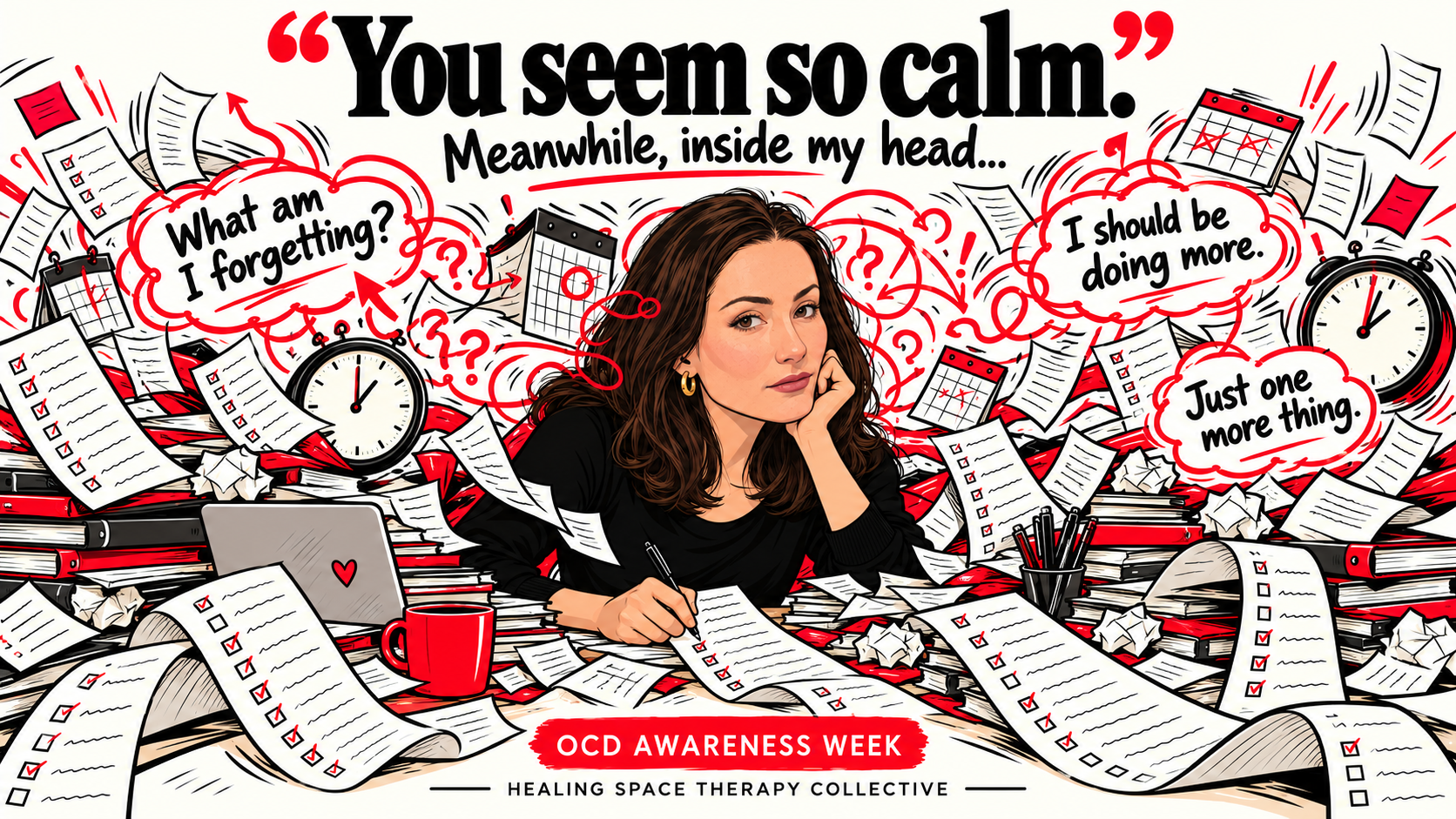
“You seem so calm.”
I understand why people say that. As a therapist, I spend my days making space for difficult feelings, helping people untangle complicated experiences, and staying present when things feel overwhelming. There is a steadiness to that work, and it’s a part of me that people often see.
What they don’t always see is the anxious, task-obsessed, list-making mess that can be happening underneath. While I might look composed, my mind is keeping track of what needs to happen next, what I may have forgotten, and what I need to write down before it slips away. Sometimes, even when I’m sitting still, it feels like part of me is continuing to work.
For OCD Awareness Week, I wanted to share this part of myself because being a therapist doesn’t mean my own mind is always a peaceful place. I can help other people navigate their mental health while still having a complicated relationship with my own.
When the list becomes more than a list
As a practice owner, therapist, supervisor, partner, and mom to two young children, I have plenty of reasons to keep a running list. Between the needs of my clients, the responsibilities of running a business, and everything involved in family life, there are real things that need my attention. Writing them down can be useful, especially when I’m moving between roles throughout the day.
The harder part is when the list begins to carry more weight than it should. It can start to feel like getting everything organized and completed is the thing standing between me and being able to relax. If I can just finish these tasks, respond to those messages, and make sure nothing has been overlooked, maybe my mind will finally settle.
But there is almost always something else to add, and finishing one thing doesn’t necessarily bring the relief I was hoping for. I can accomplish a lot in a day and still feel pulled toward whatever remains unfinished, which makes it difficult to recognize when I’ve done enough.
From the outside, this can look like being organized, motivated, or on top of things. What’s less visible is how much energy it takes—and what happens when I’ve been operating that way for too long.
What it costs me at my worst
I want to be honest about the consequences, because describing myself as a busy person with a lot of lists leaves out the hardest parts.
At my worst, I feel constantly on edge, and my patience becomes much shorter than I want it to be. I snap more easily in my relationships, especially when I’m interrupted or something isn’t happening at the pace my mind thinks it needs to happen. The people I love can end up receiving the frustration of a mental load they can’t fully see.
I can also become hyper-independent, taking everything on myself because I don’t feel patient enough to wait, explain what I need, or let someone approach a task differently. Doing it myself may seem easier in the moment, but it leaves me carrying more, feeling more overwhelmed, and having even less patience available. It becomes a cycle that is exhausting for me and difficult for the people around me.
Then there is the absence that can happen even when I’m physically there. I might be with my children, my partner, or a friend while part of my attention is still attached to something unfinished. I want to enjoy the moment, but my mind keeps pulling me toward what comes next, and afterward I feel guilty for not having been more present.
That guilt can follow me from one role to another. When I’m working, I worry that I should be spending time with my family; when I’m with my family, I think about the work I haven’t finished. When I try to rest, I can feel guilty about both. There is an ongoing sense that, whatever I’m doing, I’m somehow supposed to be doing something else.
During these harder periods, I also experience anxiety attacks and difficulty sleeping. I notice physical pain and times when I seem to get sick frequently, too. I don’t assume OCD explains every physical symptom, but those experiences are part of the picture of how depleted I can become, and they deserve attention in their own right.
This is me at my worst, rather than how I feel every day. Still, it matters to name it, because being able to keep functioning doesn’t mean I’m doing well.
Caring about everything can leave very little room for myself
I care deeply about my clients, the practice I’ve built, the clinicians I support, and the family I’m raising. I want to be thoughtful, dependable, and present, and those values bring real meaning to my life.
But caring can become tangled up with feeling responsible for every detail, and it can be difficult to notice when thoughtful attention has turned into mental overwork. People often see the finished work or the thing I remembered, while I’m left managing the pressure that went into it.
I don’t want to care less about my life. I want to care in a way that leaves room for my health, my relationships, and the ability to enjoy what I’m working so hard to support.
That means acknowledging that my own care cannot always be the thing I get to after everyone and everything else. If I wait until there is nothing left to do, I will keep waiting.
What helps me come back to myself
Maintaining my own self-care makes a meaningful difference in how grounded I feel and how I show up with other people. For me, that includes workouts, walks, and time in nature, where I can move my body and give my attention somewhere to go beyond a screen or a task.
It also includes screen-free weekends with my kids, cooking, reading, and spending time with friends. These are parts of my life that I need to actively protect, particularly when my instinct is to use every available moment to catch up.
Cooking gives me something tangible to focus on, while reading lets me spend time with a story that has nothing to do with my responsibilities. Being with friends creates room for connection and for parts of myself that can get crowded out by work and parenting. Time outside and time with my children help me return to what is happening around me, rather than remaining absorbed in everything happening in my head.
None of these things makes OCD disappear, and I don’t see self-care as a substitute for treatment or support. They help sustain me, though, and neglecting them makes it easier for my world to shrink down to responsibilities, urgency, and whatever I haven’t finished yet. Therapy also helps me stay on track. Seeing my own therapists puts worries into perspective when I become hyper-fixated on something that feels really big and insurmountable, but can be broken down into digestible parts or isn’t actually my problem to solve at all.
I’m learning to recognize that these activities deserve a place in my life even when I’m behind. Especially then, I need opportunities to feel connected, to experience pleasure, and to remember that my time has value beyond what I produce.
Being a therapist doesn’t make me immune
There is a particular vulnerability in knowing the language for what you’re experiencing and still finding it hard to move through. I can recognize a pattern and understand it without being able to immediately step out of it.
Sometimes I expect my training to make this easier, as though understanding mental health means I should always be able to manage my own. Yet I would never expect a client to stop struggling simply because they understood their struggle, and I’m working on extending that same compassion to myself.
That compassion also needs to include responsibility. When I’m snapping, withdrawing into doing everything myself, in physical pain, or struggling to be present, I want to notice it and respond. I can acknowledge what I’m experiencing while also recognizing its impact on the people I love, making repairs when I need to, and giving my own needs more attention.
Making room for the whole picture
My list-making is one part of what I’m choosing to share, rather than a complete account of my OCD. Making lists, being busy, or enjoying organization does not, by itself, mean someone has OCD, and everyone’s experience is different.
What I want to make more visible is the distress that can exist behind a capable exterior. Someone can be meeting deadlines, caring for others, and keeping things moving while struggling with how much it is taking out of them.
I don’t mind being described as calm, because sometimes that is exactly how I feel. I value my ability to be grounded with another person, and that steadiness is real. So are the moments when I feel overwhelmed, impatient, anxious, or disconnected.
For OCD Awareness Week, I’m making room for all of that. I’m proud of the life I’m building, and I want to be well enough to participate in it—to enjoy my children, connect with my partner, family, and friends, and spend time doing things simply because they make me feel good.
I’m still learning how to let a day end with things unfinished. Part of that work is trusting that taking care of myself belongs on the calendar even when the list is long, because the people and experiences I care about deserve a version of me who has something left to give, and I deserve to feel that way, too.
Anna Halliday, LMHC-QS, CST
Founder and Lead Therapist, Healing Space Therapy Collective